
Planact’s Monitoring Indoor Climate Extremes with Residents (MICE-RIOT) project is responding to the severe heat communities are experiencing, especially in their homes, turning these spaces into very difficult and sometimes dangerous places to live in.
It is for this reason that indoor heat is being tested in two informal settlement communities in Choba in Olievenhoutbosch, Centurion in the City of Tshwane and in Watville in the City of Ekurhuleni. It is a response designed to understand how housing characteristics and house types affect living conditions through the lens of higher heat levels as a growing trend of a warming climate. There are increasing reports linking heat to serious health risks, and Gauteng’s Heat Action Plan, with its early warning systems and phased approach, firmly establishes public health as fundamental to protecting, as part of an effective short, medium and long-term response.
Gauteng’s summers will be characterised by more hot days, and by 2050, these are expected to increase sixfold, with significant implications for health, economic stability, and infrastructure. This poses increasing challenges for policymakers. Hot days have high ambient temperatures, typically exceeding a local threshold of 30°C. Another pattern is the presence of summer temperatures extending into the autumn months. In South Africa, research indicates that maximum temperatures are rising fastest during the autumn and spring seasons.
In the same city, the temperature difference can be as much as 6 to 10°C. Planact’s heat-mapping reveals that informal settlements are far hotter than suburbs with trees and better housing. South Africa’s spatial patterns, a legacy of apartheid, demonstrate most clearly where heat in cities is concentrated, typically in areas where township communities and informal settlements are located. One of the key disparities is an absence of urban planning that has not considered green spaces and tree coverage, and budgets that have neglected infrastructural investments, including social infrastructure. It is these areas that are the most affected by heat and require targeted interventions. It is also these areas that will be least prepared to deal with the impact of warmer temperatures and the resultant health concerns.
While outdoor temperatures rise, what is happening indoors? Planact’s research is demonstrating that building characteristics are vital in piecing this together. It matters whether you live in a house constructed primarily with metal sheets or a brick-and-mortar home. Roofing materials, the absence or presence of ceilings, ventilation, and housing orientation all matter in a warming climate. So does the absence or presence of trees for shading and green spaces.
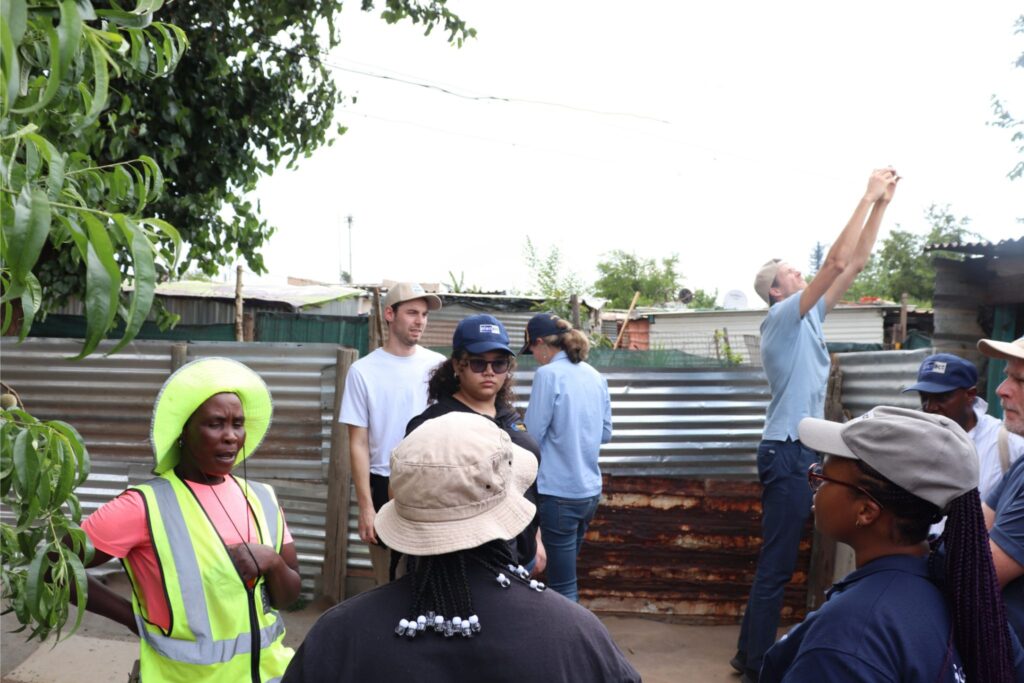
Temperatures are becoming unbearable for residents who are enduring these conditions, and their only home is a ‘shack’ made of metal/corrugated iron.
A visit by the Rockefeller Foundation for meetings brought public health concerns to the fore. They highlighted growing evidence linking extreme heat to serious health risks, including cardiovascular strain, kidney disease, and respiratory conditions, as amongst the serious risks. Some of these ailments are more prevalent among outdoor and agricultural workers.
Heat is already having a tangible impact on communities across Gauteng. Seniors and young children are particularly vulnerable to rising temperatures, experiencing symptoms such as fainting, skin rashes, dehydration, and dizziness. Prolonged exposure to extreme heat is also affecting livelihoods, with reduced productivity—especially for those engaged in outdoor work during peak daytime temperatures. Despite these growing risks, the health impacts of heat remain poorly understood at a community level, making it harder for residents to recognise, respond to, and mitigate these effects.
Residents describe conditions in these homes as unbearable in the summer. Planact’s studies of indoor temperatures have been captured by heat sensors, which have recorded temperatures in places like Choba exceeding 35 degrees over the October 2025 to March 2026 period.
Working closely with communities, Planact has been able to help build a clearer picture, through the evidence it is generating, as to how indoor heat levels are impacting their health.
Planact recognises that interventions to address heat must take place at the household, city, local municipal, provincial and national levels.
The project is beginning to show that strong data and evidence can drive real momentum for change, with community leaders increasingly mobilising and building collective action.
The project is advocating for a real shift to heat-responsive building regulations that account for extreme heat. Our work is demonstrating the importance of orientation, roof and wall materials and ventilation. These lay the basis for building a reform agenda to press for reform to building regulations. Cool roof, building and infrastructure technologies will need to be a fundamental part of preparing for a future marked by extreme heat.
It is also important for greening activities to be incorporated into neighbourhood and urban plans and design, through active tree-planting campaigns that can be driven and monitored at the community level. Tree cover can significantly protect communities against extreme heat.
Planting trees and investing in green spaces does more than cool communities. These nature-based solutions can also reduce flooding, support biodiversity, and make neighbourhoods healthier and more liveable.