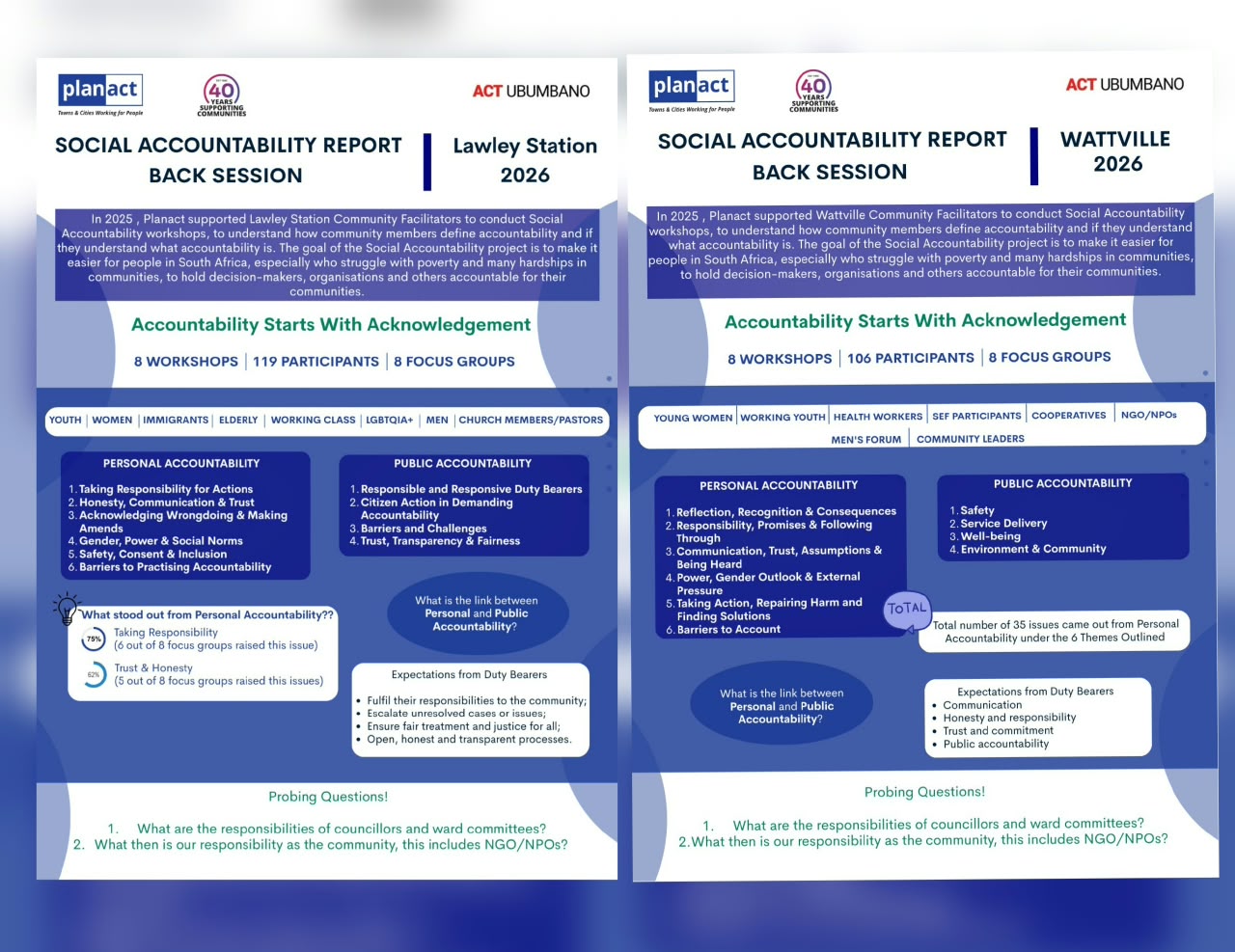
Planact supported community facilitators in Wattville and Lawley Station to host Social Accountability report-back sessions on 11 and 16 September 2026, respectively. The sessions brought together community members, facilitators and Planact staff to reflect on findings from 16 Social Accountability workshops, identify key challenges affecting service delivery and develop community action plans to strengthen accountability and engagement with relevant stakeholders. The Wattville session had 19 participants, while the Lawley Station session had 15 participants.
Community Reflections and Key Findings
During the sessions, participants reviewed the findings from their respective workshops, discussed the challenges affecting their communities and identified areas requiring action.
Wattville Community
In Wattville, the discussions highlighted social ills, poor communication, a lack of trust and limited accountability as factors affecting service delivery. Participants raised concerns about crime and access to clinic services, including negative experiences with clinic staff, medication shortages, insufficient nursing staff, the absence of a social worker and patient confidentiality.
The community identified the need for support to re-establish the patrollers’ structure, strengthen relationships between patrol structures and address challenges that had previously affected the structure. Regarding clinic services, participants proposed engaging with the clinic committee to better understand the clinic’s operations and structure, including the process of establishing a clinic committee.
Lawley Station Community
In Lawley Station, the discussions highlighted communication, power and authority, gender and accountability, access to information, and politics and guidelines as factors affecting service delivery. Participants emphasised the need to better understand government structures, the responsibilities of different spheres of government and the policies and programmes that affect their communities.
Background: Strengthening Social Accountability
In 2025, Planact supported Wattville and Lawley Station in conducting Social Accountability workshops to explore how community members understand and define accountability. The Social Accountability project aims to make it easier for people from marginalised communities to hold decision-makers accountable.
The report-back sessions built on these workshops by giving participants an opportunity to reflect on the findings, identify pressing community challenges and determine practical action plans to address them.
Action Plans
Lawley Station Action Plans
The discussions in Lawley Station highlighted the need for ongoing support to help community members understand government processes and access information about relevant policies and programmes.
Participants identified the Upgrading of Informal Settlements Programme (UISP) as an example of a policy they need to understand better to engage with the government and advocate for appropriate development interventions. Greater access to information about government responsibilities, public representatives and available channels for raising concerns can help communities participate in decision-making, identify responsible institutions and monitor government commitments.
Wattville Action Plans
In Wattville, the proposed actions focused on strengthening community safety structures and improving engagement with the clinic committee. These priorities reflect the need for communities to understand how relevant structures operate and how to engage them in addressing service-delivery challenges.
Priorities and Recommendations
The discussions identified several priorities for future engagement:
- Continue accountability workshops: Strengthen community members’ understanding of accountability and government processes through ongoing learning.
- Improve access to information: Provide simplified information on government structures, policies and programmes, including UISP.
- Strengthen community participation: Create opportunities for communities to engage with public representatives and relevant government officials.
- Link knowledge to action: Support communities in identifying practical steps to address their challenges and following up on commitments made by relevant stakeholders.
Supporting Community Action Plans
The report-back sessions provided an opportunity for Wattville and Lawley Station community members to reflect on service-delivery challenges, identify priorities and develop community action plans. The next step will be for Planact to meet with community facilitators from both communities to discuss and plan how best to support the implementation of these action plans.
The planning meeting will provide an opportunity to identify the support required by each community, agree on practical steps and determine how to work with relevant stakeholders to address the challenges identified. This process will build on the discussions from the report-back sessions and support communities in taking forward their identified priorities.
Accountability Project
In 2025, Act Ubumbano and SIVIO Institute partnered with Planact to conduct Social Accountability workshops with their partner communities, drawing on Planact’s established presence in Gauteng’s metropolitan municipalities.
Planact coordinated activities in two partner communities: Lawley Station Informal Settlement in the City of Johannesburg and Wattville in the City of Ekurhuleni. Each partner community hosted eight workshops, bringing the total to 16 Social Accountability workshops across the two communities.
As mentioned above, the goal of the project is to empower community members, particularly those experiencing poverty and other hardships, to hold decision-makers, organisations, and other relevant stakeholders accountable.