In 2024, MASCOM, the Emalahleni Cluster of informal settlement communities, supported by Planact, engaged in a community-led social audit on potable water. The intention was to monitor the quantity and quality of potable water delivered to communities through municipal services and municipal contracted water trucks. From the social audit that was conducted with the community, responses suggested that there were water quality issues. Planact, in a second phase of the 2024 social audit, engaged with the University of Johannesburg’s Process, Energy and Environmental Technology Station (UJ-PEETS) for in-depth water quality testing in informal settlements in Emalahleni. Through engagements and consultations with UJ-PEETS and their feasibility study conducted prior to the testing, there have been reported cases in which residents believed they became ill due to the water consumption in Emalahleni. UJ-PEETS recommended comprehensive microbiological testing and chemical analysis to detect contaminants in the potable water to strengthen the data collected during the social audit and effectively address and clarify water quality concerns. Through multiple conversations and engagements with UJ-PEETS, it was agreed to test water in two communities at key points:
- The water truck delivering water to the community the transportation phase,
- Water directly from a communal water tank as the distribution point, and
- Water from a household that uses water from the communal tank which is the consumption point.
This method of sampling from multiple sources is to test the areas for possible contamination of potable water in communities and identify the stage at which the safety of water is compromised.
On the 25 August 2026, the Planact and UJ-PEETS teams set off to Benicon and El Paso in Emalahleni Local Municipality, Mpumalanga to begin the water sampling of the key points in both communities. Prior to the day of the water testing, Siphiwe Segodi, Planact programme co-ordinator, engaged with the MASCOM cluster through a desktop study and site visit to identify the two communities, two communal tanks, two households and arrange to access to two trucks for sampling. Three communities: Benicon, El Paso, and Masakhane were identified as testing sites, and are all in proximity to one another. Community members from Benicon and El Paso were confident that water trucks deliver water on Tuesdays and assured the Planact team that they are able to contact the water truck drivers to ensure that they can be in the community on the day of testing. As part of the planning and as a precautionary measure, Masakhane was kept as an additional community for testing.
Sample Collection from Distribution Point and Consumption Point
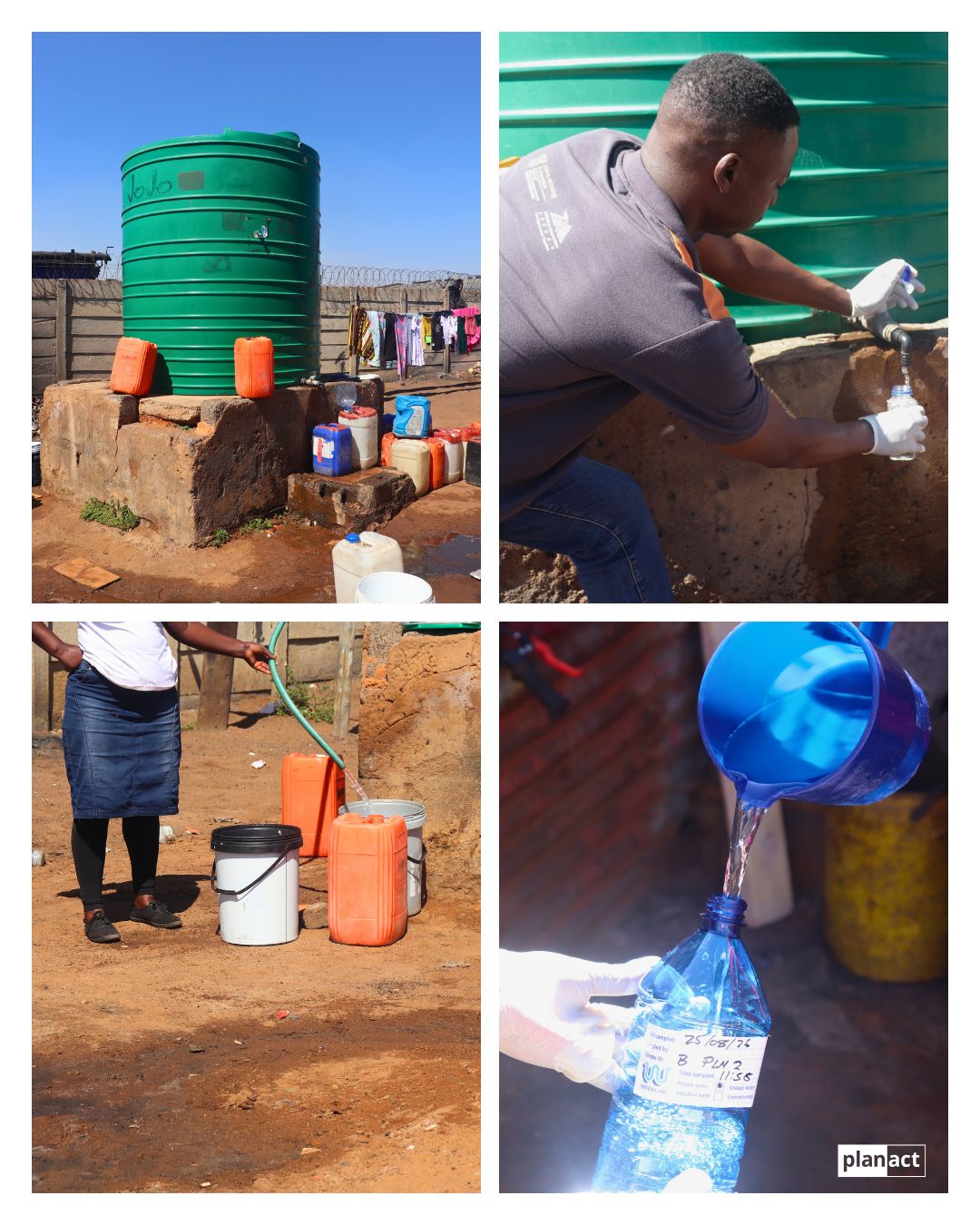
The water sampling was welcomed by the cluster and the participating communities and the Planact and UJ-PEETS teams were met by community representatives that assisted at the sampling key points and facilitated the engagement with the community. UJ-PEETS collected water from water bottled provided by the laboratory that had seals placed over the lid with labelling for noting the date of sampling, sampling by and sampling date identification, time samples first from two communal water tanks in both Benicon and El Paso. From the water tanks verification activity that observed the quality of water tanks in communities in the 2024 social audit, 65 tanks were in a poor condition with missing tank lids and broken or leaking taps. Close to two years after the social audit, both communal tanks identified by representatives were still in the same condition with missing tank lids and leaking taps. Although covers were missing from the tanks in both communities, the El Paso community had pipes running from the top of the water tank as an added method for the community to collect water from the tank beyond the preinstalled tap.
Sampling at the consumption points displayed two different methods for how water is stored in homes. It was significant that the sample needed to come from a household that collects water from the same tank used in the study and, if possible, from a household that collected water a few days before the sample collection. One household was successfully identified in both communities that showed two different methods that households use to store water. The household in Benicon stored their water in an open plastic oval bathtub kept indoors, and in the El Paso household water was stored in a plastic water dispenser outside their house.
Another key element of the social audit was to enquire from the community about how often communal tanks are cleaned and by whom. At the time of the social audit in 2024, communities stated that tanks had not been cleaned or were cleaned through community efforts, but it was not consistent. In both communities, the representative explained to Planact and UJ-PEETS that since their water tanks have been installed in the communities, they have not been cleaned. The Benicon water tank tested was installed approximately eight years ago and has never been cleaned. The tank tested in El Paso has been in place for approximately six years and has equally not been cleaned. The fact that the tanks are not cleaned and are not covered raises concerns about water quality.
Sample Collection from the Transportation Point
Although both communities confirmed that water delivery happens on Tuesdays and were confident that the trucks would be in the communities on the day of sampling, due to the inconsistency of the water delivery route while sampling was taking place in Benicon Planact was alerted that the water truck was in El Paso and by the time the team arrived in El Paso the water truck had moved on to the next community. Through engagements with the water truck dispatch co-ordinator who provided the phone number of the truck driver, the team learnt that the truck had just completed filling Benicon water tanks and was heading to the filling station. The water truck driver agreed to meet Planact and UJ-PEETS at a meeting point for the water collection. As the teams rushed to the meeting point, there was a water truck parked already at the point, and it was assumed by the teams that this was the truck that delivered water to El Paso and Benicon. It was in a poor condition with leaking pipes, and the body of the tank was rusted. It was later clarified that the first truck does not deliver water to El Paso or Benicon but delivers water to Masakhane. Due to the tank being in a poor condition, it was decided to use the last testing bottle to sample a tank in Masakhane
UJ-PEETS collected the samples from the water truck that delivered water to Benicon and El Paso as planned and with permission from the truck manager, and after many attempts to contact the truck driver, a sample from the truck that supplies Masakhane was collected. Through Planact’s effort to locate the water trucks for sampling the team learnt about the filling station for the water trucks, this was identified as a possible key point for sample collection but due to the lack of information on the filling stations prior to water testing this key point for sampling was not accounted for. This meant that water could not be sampled from this key point but out of interest after the UJ-PEETS team departed for Silverton, Tshwane to deliver the water samples to the laboratory for testing the Planact team set out for the filling station.
Citizen Science Water Quality Testing
Planact has established a partnership with WaterCAN (Community Action Network), an organisation of citizen scientist activists committed to advocating for clean, safe and sustainable water, to begin water testing in six informal settlement communities in Gauteng’s three metros. Through this partnership, Planact obtained seven water testing kits from WaterCAN that test for harmful bacteria and basic water quality. While collecting water for the laboratory test, the UJ_PEETS team collected water samples to facilitate the citizen science tests. Planact independently sampled water from the Masakhane water tank as discussed above, about the condition of the water truck to Masakhane and the interest of the quality of water in the communal water which was an addition decided on the day of testing. The Planact team conducted water testing with the use of the WaterCAN testing kits. This added testing was an opportunity for the two testing methods conducted to compare the results between UJ-PEETS and WaterCAN and lead to further engagement on how continuous water testing can be conducted in Emalahleni.
Way forward
Currently Planact is eagerly waiting for the water testing to conclude and the results to be released. They are expected by mid-October 2026.
UJ-PEETS with Planact support will share and present the water testing results to the MASCOM communities that participated in the 2024 Potable Water Social Audit and the 2026 Water Testing. It is expected that Planact and UJ-PEETS will engage the relevant government department on a national, provincial and municipal level.